Wednesday, 6 August 2014
voltex: firefly


tac_: little_courage & my_magic
Then there’s tac_ for whom vocaloids are a perfect element gently woven into dainty, elfin compositions. Another sound tac_ frequently uses is that of the mellotron, which in many ways is the forerunner of the vocaloid, being an analogue sample-based synthesiser where keys were attached to tape loops featuring recorded instruments such as strings and flutes (you might know it from the opening to “Strawberry Fields Forever”). Both dolls designed to emulate more organic musics, the vocaloid and mellotron complement one another not as fake, insufficient, robotic entities, but as toys that have run away to a miniature fantasy kingdom where they can now be loved only by history and nature.
Alongside the mellotron, the vocaloid becomes a velveteen rabbit, fleeing from revulsion and supercession and becoming magically real among the fireflies, brambles and dark blue evenings.
Sunday, 3 August 2014
polygron prompt: avarice
Sorry for the mp3-blogging pause. Gonna upload a few of my favourite vocaloid tracks (in the wake of my piece featuring em). This one, 'Avarice' by Polygron Prompt, is from 2011, but it really got me, bringing out the strange, fragile quality of the medium. It's Hatsune Miku, and she's singing against a techy jungly beat that suggests a futuristic computer game circa 1998, all its constituent elements propelled forward and spread out into mystique diffusion as if in search of bots to frag. The kicker is the tangibly dissonant way Miku sits on top of it, especially at the ends of her phrases. Intended or not, it's the perfect setting for vocaloids' technocratic uncanniness.
Thursday, 17 July 2014
System Focus: The Evolution of the Voice in the Digital Landscape

You might say that the voice is the most human of all the elements in music. It comes from deep within our bodies, organically, ever since we came to be human, and indeed long before. It is probably the first musical instrument that we learned to recognise, and, since it is built into most of us, the first that we learn to use. Yet the voice is much more than just a sound, however primordial. It represents a person: their activity, agency, opinions, experience, their self-projection. In doing so, it differentiates itself from the environment around it, musical or cultural, either drawing power from this context or somehow standing against it. Or, most intriguingly, doing both at the same time...

Roger Troutman of Zapp using a talkbox
There’s a tendency to regard the digital world as non-human, as encroaching on humanity, but I think that’s quite wrong. The internet is not just a landscape made up of technology, it is one made up of humanity. Like it or not, Facebook and Twitter are made of people, and of people’s voices in particular. People’s voices and the lives behind them reduced to assertions, opinions, arguments, anxieties, reduced to pieces of data, to samples—but sounding out nonetheless. And this landscape is reflected and explored in the music it produces, where the lines between the human and its technological environment are no longer clearly drawn...The final tracks of both albums (called “Landscapes” on Spirit Sign) feature synthesised speech, as if completing a transition from human to machine, yet it’s set against some of Nima’s most elegant instrumental textures. At the end of SEE FEEL REEL, a voice almost obsessively repeats crypto-romantic refrains such as I’m… in love… with… the… digital age… over strings, before switching to breathy voice-like tones as if it were dissolving into air. Nima’s music certainly lives in the digital age, and all the elements within it expand to fill the enormous space that results...

Nima's SEE FEEL REEL
Both musically and conceptually, the album suggests a dream cityscape as it might have appeared at the turn of the 1990s, a weird, multicoloured, postmodern union of the past and the future, where citizens of all professions glide beatifically down immaculate beige sidewalks past bright red fire stations, neo-1930s banking skyscrapers, parping bandstands, faux-eighteenth-century colleges, and green, green, lawns, all presided over by a moustachioed mayor who warmly greets his public at the exponential tree-planting and ribbon-cutting ceremonies. One of the crucial components of this digital landscape—now looking rather misplaced, both poignant and arrogant, in the post-recession era—is the voice. Fittingly, the vocals, and the human beings hinted at behind it, are just yet further objects swirling in the cityscape, forming its melodies, scatting ooh and aah or urging Work it! and Get down like feckless, automated cheerleaders. It’s a landscape we might recognize and enjoy with a little disquiet mixed in...
Metallic Ghosts' The City of Ableton
Sampling processes of all kinds appear in Blank Banshee’s album Blank Banshee 1, a masterwork of the new digital psychedelia, and it’s quite easy not to really notice that the album is filled with voices at every turn, much like its videos are filled with virtual beings, objects and environments. Despite the fact that these voices are pitched up, down and all around, they’re never more than virtual avatars of their owners: social media masks that are both freeing and constraining. Freeing in that they allow the voice to move to new places and be new people, constraining in that these surrogate people are not yet as infinitely flexible and free as they would like to think they are, and might still have an air of the uncanny about them. This double-edged nature of the human user in the modern digital playground, its mixture of strange new opportunities and dangers, might be why one of the tracks goes by the name “Anxiety Online...”

Blank Banshee's Blank Banshee 1
Voltex makes gorgeous footwork-like tracks from joyfully leaping vocaloids and stereophonically pingponging synths. Then there’s tac_ for whom vocaloids are a perfect element gently woven into dainty, elfin compositions. Another sound tac_ frequently uses is that of the mellotron, which in many ways is the forerunner of the vocaloid, being an analogue sample-based synthesiser where keys were attached to tape loops featuring recorded instruments such as strings and flutes (you might know it from the opening to “Strawberry Fields Forever”). Both dolls designed to emulate more organic musics, the vocaloid and mellotron complement one another not as fake, insufficient, robotic entities, but as toys that have run away to a miniature fantasy kingdom where they can now be loved only by history and nature...
Top Vocaloid Hatsune Miku
Wednesday, 25 June 2014
System Focus: Inside the New Digital DIY Labels

Photo by Andrew Volk
Apologies for the delay - the second System Focus for the Fader is out (click here to see it) and it's based around a series of interviews with some labels in the online underground: Illuminated Paths, Ailanthus, 1080p, Zoom Lens, Dopefish Family and Aural Sects. This one was a real pleasure to put together, as I got to learn about how things work behind the scenes at some of my favourite labels on the emerging frontiers of underground operation, and discovered a real community.
You might have expected [the growth of the internet] to make labels—whose role it usually is to organise the discovery, representation, manufacturing and distribution of their artists’ music—redundant in the modern era. And as a result, you might have expected music producers and their listeners alike to be reduced to an atomised population of lone computer-clickers. But curiously, labels are flourishing, and they form key nodes in a new form of DIY musical culture that is as sociable as ever. How did these online labels form and who’s behind them? How do they work, and what drives them?...

The folks behind Aural Sects (image by Micah Clark)
One of the things that kick-started my curiosity about this new class of labels was when I received a box from Florida. It had been packed by Josh Rogers, the current manager of the Illuminated Paths label. As well as several cassettes (including a reissue of LATE NIGHT DELIGHT by Luxury Elite and Saint Pepsi, one of the key vaporwave albums), it contained a map of Historic Downtown Melbourne, FL, a State Farm Insurance keychain, a Lucky Charms straw, a section of a t-shirt from the Bluewater Network, a newspaper called Pet Gazette (featuring the cover line “Your Valentine Pet is Right Before Your Eyes-LOOK Inside!”), a couple of off-brand Pogs (remember them?), a toy cow you can clip together, all kinds of flyers, and, best of all, an expansive bib for a restaurant called Captain Quackenbush: The Seafood Specialist, featuring an ecstatic cartoon lobster (who is, in turn, wearing a Quackenbush bib). Not the sort of thing you find in England, where I’m based. Rogers often mails off cassettes with, as he puts it, “local and abroad ephemera from my travels and otherwise” included...
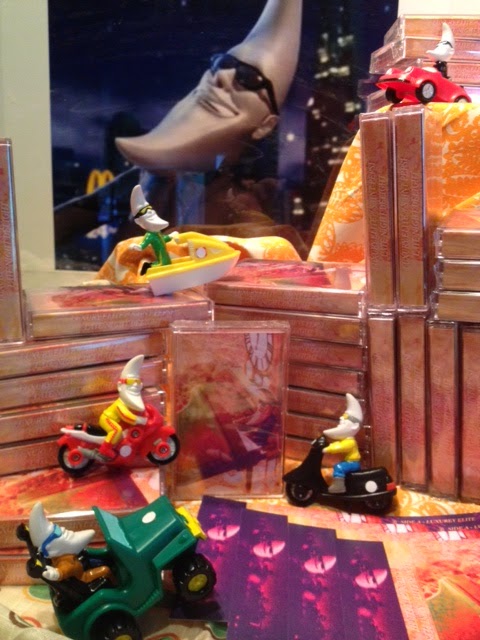
LATE NIGHT DELIGHT cassettes, care of Illuminated Paths
“We made secret, closed and public Facebook groups wherein we actively
developed brand new cultural signifiers for our new community. Each and
every one of us was doing something completely different from the next
and we were all coming from such vastly different backgrounds, cultures,
generations, class, etc. Collaboration was key, we all supported one
another and that naturally lead to collaborations, cross country
meet-ups, labels, websites, web concerts, we started doing whatever we
wanted. The community is different for everybody, but it means a lot to
everybody.”...

Zoom Lens art
The Zoom Lens label goes even further with the net-based ideology than Aural Sects, emblazoning its Bandcamp page with the legend “WE ARE A LABEL AND COLLECTIVE OF MUSICIANS. HUMANITY ACROSS THE DIGITAL DIVIDE. DIGITAL PUNK ROCK SPIRIT. FUCK REAL LIFE.” Today, the label has a clear Japanese-influenced aesthetic of sweetness and dreaminess, with joyous 8bit from Yasumiyasumi and Slime Girls, and gentle pop from Yoshino Yoshikawa, Yeule and i-fls, bittersweet like a green tea latte on a rainy Sunday afternoon... the Japanese connection “has given Zoom Lens its sense of ‘punk rock’ aesthetics. To enjoy anime in the United States is punk rock. To listen to J-Pop is punk rock.”...

Dopefish Family's Andrei Mitroshin
Many of these labels manifest IRL by releasing on physical formats, of course. For most online labels, that means mail. “Oh man, so much mail,” says 1080p’s MacFarlane. “These days I’ll go once or twice a week down to the post office in Chinatown on my way to school, where I’m on very good terms with the ladies who work there.” But it doesn’t work everywhere: “Russian post is bloody hell,” says Mitroshin of Dopefish Family. “So all physical stuff we make (or will make) goes only with our friends or people that can reach us here.” MacFarlane is fond of cassettes, though: “The physical practicality of them, they are nice and small to post, cheaper and lower risk to manufacture than vinyl and I’ve always had cars with tape decks.” They’re also “like a more casual place to experiment than vinyl that can be released reasonably quickly.”

1080p's Richard MacFarlane
Garrett hopes the label can “move into the direction of digitally tangible releases or limited art pieces. I feel like the existence of physical items is important in preserving our own attached memories to such listening experiences, yet sometimes I feel like it’s impractical in an ecological sense and is slowly growing less acceptable for the shifting musical listening trends.” Then, elegantly and poignantly echoing Zoom Lens’s sonic and visual aesthetic: “We are in constant conflict in losing the physical things that bring us a sense of connection, yet we enjoy the ease of instant gratification.” Ailanthus’s Michael confesses, “I always wonder where these files will be in decades, like what if kids go to thrift stores and rummage old external hard drives for rare internet music.”
Monday, 2 June 2014
DYNOOO: These Flaws Are Mine To War With
DYNOOO caught our attention last summer with Mesh N2 Air, with its flux-engineered biospheres populated by brave new creatures. This new free mixtape, These Flaws Are Mine To War With (grab it on Datpiff), I like even more. That air of hi-tech naivety (the mind of an AI) becomes more assertive, more captivating, as the newly evolved material (part plant, part fish, part plastic, part silicon) presses against the geodesic panels, and darkly, calculatingly shows its new visage to the supervisors. Try 'Beyond M,' 'CR X' or 'AXs (Ma Benchpress).' And like another comparable recent release, Sentinel's hybrid, it suggests all this without overt conceptuality. These are just some sounds. Sounds in strange and compelling arrangements. The way things sound today.
Subscribe to:
Posts (Atom)


 Posts
Posts

