Sunday, 15 January 2017

Negativity, Not Pessimism! (RIP Mark Fisher)

I was so shocked and upset to learn of Mark Fisher's death yesterday. For me, Mark was both an idol and, as time passed, someone I was always pleased and not a little humbled to encounter in person and sometimes share a platform with. I didn't know Mark very well personally, and being a generation younger than he was I only know second hand the milieu of the 90s and the Cybernetic Culture Research Unit at Warwick University he formed an integral part of, through its growing legacy and some of the reminiscences and thoughts of people who knew him then (Robin MacKay, Simon Reynolds and Jeremy Greenspan among them). But as someone a generation younger than Mark, I can express something about the incalculable impact he had on me, my thinking and writing, and my gratitude for the times when he actively, kindly helped me, as well as the times that were just good times.

Mark simply changed my life. By 2009, the year I started the blogging that would lead to music criticism, he was a central node in a network of bloggers, thinkers and forums that encompassed critical theory, philosophy and several areas of cultural criticism, especially of popular music. It was a conversation and a community I eagerly wanted to participate in, late and all too hot-headed though I was. As commissioning editor of Zer0 books, he fostered the growth and evolution of this network into a collective of thinkers built on diverse, self-contained and regularly powerful statements that went far.
Mark's own essay for the imprint, Capitalist Realism: Is There No Alternative? was undoubtedly one of the best of the lot. I continue to recommend it widely as one of the best, most distilled expression of today's ideological challenges. By the end of 2009, Mark had reached out to me and asked if I wanted to write for Zer0. I was 23. Infinite Music was the result two years later. He told me that I should reconsider the title I had initially proposed - 'The New New Music' (can you believe that!?) - which didn't take Mark's genius, but thank God. His faith in me - this despite my frequent and often crude HTML critiques of his positions on music - led to so many amazing opportunities and blessings for the struggling, wet-behind-the-ears critic I was.
I first met Mark in person in April 2010 when we were both part of a panel discussion at London's Café OTO, a 'salon' under the auspices of Wire magazine: 'Revenant Forms: The Meaning of Hauntology'. He was warm, friendly and funny back stage, powerful, precise, provocative and funny on-stage. Someone I brought to the event who didn't know Mark and his ideas said to me 'but capitalism is the only system that works!' (this of course is precisely what Capitalist Realism describes and addresses). I believe I next saw him marching alongside thousands of students at one of the protests against the raising of tuition fees and the cutting of the university teaching budget in late 2010, an issue that inflamed and unified the blog network like nothing else, not least Mark himself.
At some point in 2011 I was at a gig behind a pub at which Maria Minerva was playing. Maria had been taught by Mark during her Master's at Goldsmith's college. In an amazing moment, Maria gave a shout-out on stage to her 'professors' - I followed the direction of her outstretched arm, and there was Mark, leaning against a wall next to Kodwo Eshun. I saw him at least twice in 2013, once at a symposium at Warwick University on the Politics of Contemporary Music, where I burned with envious ambition at his ability to deliver such an on-point, appropriate and funny lecture from only a small notebook. The other time was in Berlin, where I was talking about accelerationist pop for the CTM festival, Mark was there to talk about the death of rave. We walked from our hotel to the venue, had lunch, and Mark talked sympathetically and encouragingly about my career difficulties. He sat in the front row of the talk I gave (and contributed really insightfully to the discussion afterward). I played some of the kitschiest vaporwave as the audience came in. I'll never forget the bemused look on his face, as if he was trying to figure out what sort of a hilarious prank was being played, and whether he wanted in on it. That image of Mark is still for me the opposite end on the spectrum of vaporwave listeners to the one where vaporwave is, uncritically, 'just good sincere nostalgic vibes', and it's why I have no regrets about 'politicising' vaporwave (a genre that in any case owes an enormous debt to his theorising of hauntology).
But for me there was another Mark as well - the formidable writer and theorist, k-punk. This voice I began to get to know in 2006, the year when he did so much to lay the foundations of hauntology (it was his invention, frankly). It was from k-punk that I learned about something called 'neoliberalism' ('what on earth has this guy got against liberalism?' I would wonder). It was from k-punk that I learned that post-modernism was not necessarily the wonderful cultural emancipation I had naively believed it to be. In fact, during these years I was mostly against k-punk. He was critical of more recent trends in electronic music, believing them a poor comparison to what the 90s had offered. This led to a fierce division between writers and bloggers that manifested not just in blogs but magazine sites and a day-long conference at the University of East London, which I attended (the first time I saw Mark in the flesh). Though we both agreed that new music was necessary, naturally his position irritated my young, idealistic self with my special music, and my own blog posts attempted to intervene in support of the new stuff. 'Loving Wonky', my first blog post to attract more than a handful of readers, was directed at k-punk implicitly throughout and at its conclusion, explicitly.
This negativity that got me started, this need to talk back to the authority figure, was a testament to the power of his writing. But more so was the way he subsequently taught me as I took a closer look. In preparation for my post on hauntology, I printed out and re-read everything he'd written on or near the subject, underlining and making notes. And he convinced me of his position. He was right. I didn't want to accept his theorising of 'the end of history', thinking it merely pessimistic. Yet his blog posts are so imaginatively, seductively, persuasively written. He's probably the most referenced person on Rouge's Foam. Then I read Capitalist Realism, and rather than the mere youthful defence of certain musics it could have been, Infinite Music became an attempt to stand with Capitalist Realism and answer k-punk's resounding call for a newfound creative imagination. Later, in 2012, it was from k-punk that I learned of accelerationism, and because of his theory that I used it to describe new forms of electronic music in 'Welcome to the Virtual Plaza.' And it wasn't only theory. Wherever I wrote about music and Mark was writing too (Wire, Electronic Beats), my writing was improved by the honour and by his raising of the bar (this was the guy who had described Michael Jackson as 'only a biotic component going mad in the middle of a vast multimedia megamachine that bore his name.')
Mark isn't just the figure behind every significant thing I've done as a critic. His theory is now deeply embedded in who I am and what I say. Even the residue of the ideas I have fought against condition my thinking. I have brought his concepts home, they structure my conversations with my friends and family. Capitalist realism: describing the ideology that miserable as it is, there is no alternative to capitalism and that's just the way it is. Business ontology: the ideology that any social or cultural structure must exist as a business. His use of the concept of the Big Other - the imaginary subjectivity supposed to hold important beliefs but may not in fact exist - has guided me through my personal response to Brexit and Trump. (By the way, I couldn't possibly summarise Mark's writing - if you haven't read it already, what are you waiting for?) Even his blackly comic image of a broken neoliberalism, as a cyclist dead and slumped over the handlebars yet continuing downhill and gathering speed, keeps coming back to me.
Mark eventually became something of a role model to me. Asked what sort of space I wanted to carve out between academia and public criticism for my own career, I have often said I wanted to be a Mark Fisher. Yet as he regularly explained with his astonishing balance of passion and precision, the world as it is today, its ideologies and its institutions - it's hardly set up to encourage fringe intellectuals. I'm not sure whether he would have fully encouraged me to aspire to his career, tied so closely as he well knew to challenges of mental health (something I started to live in 2014 when, like so many others, my PhD went nowhere). But he did warmly support and encourage my writing when so many people around me could only regard it with doubt.
One of Mark's most abiding lessons, and for me at least the key to his writing, was something he put pithily to me at the end of an email: 'Negativity, not pessimism!' I had not appreciated the subtle but important difference between the two, but then I instantly did. What a rallying call for the nightmarish 2010s. And as others have noted, it was his encouragement and optimism that was especially nourishing. It was certainly not a pessimistic new-music naysayer who wrote the final words of Capitalist Realism:
The long, dark night of the end of history has to be grasped as an enormous opportunity. The very oppressive pervasiveness of capitalist realism means that even glimmers of alternative political and economic possibilities can have a disproportionately great effect. The tiniest event can tear a hole in the grey curtain of reaction which has marked the horizons of possibility under capitalist realism. From a situation in which nothing can happen, suddenly anything is possible again.
A big long (k-punk-quoting) blog post like the good old days. I used to apologise for them. Mark never did. I still can't wait to read his latest book.
The last time I saw Mark was after Dhanveer Brar's lecture on Actress at Goldsmiths in October. He was talking to his friends and colleagues in the distance and still, even after all this time, I was too nervous to say hello. What a fool. I had not stopped to gather up and communicate Mark's importance to me until now, and I hope I don't make such a mistake again. What I've seen over the cybernetic systems this weekend has emphasised how important he was to so many others as well, and well beyond the world of theory too.
Goodbye Mark, and thank you.

Thursday, 25 August 2016

Bubblebath Episode 01 ft. Mat Dryhurst (for RBMA Radio)

Art by Kim Laughton
The first episode of my new monthly show for RBMA Radio aired a few days ago, and is archived here. Bubblebath is a two-hour show all recorded and edited by me, featuring new, typically lesser known tunes that I'm interested in, segments going for some deeper analysis, and interviews with various people from underground music culture. For the first show, I looked at the pseudo-humanistic style of James Ferraro's Human Story 3 and some other records, and talked to Mat Dryhurst about some of the problems facing underground culture today and his platform Saga. The playlist is below.

People in the US won't be able to listen to the archived version of the show for various legal reasons I'm afraid. If that's you, you might try using a proxy server, especially with different browsers. US listeners can listen to the show live without any problems, though, so I'll make sure to forewarn people in future.

· 00:00:02 – 00:02:41 Julien - Alpha Beat – Calm (from Calm 2 https://calmdot.bandcamp.com/album/calm-2)

· 00:02:41 – 00:05:28 Alfie Casanova - 4 Play – Calm (from Calm 2 https://calmdot.bandcamp.com/album/calm-2)

· 00:05:28 – 00:10:16 NKC - Salon Room – Her Records (from Hague Basement http://store.herrecords.com/album/hague-basement)

· 00:10:16 – 00:13:03 仮想夢プラザ - 秘密 – Plus 100 Records (from Balance with Useless https://plus100.bandcamp.com/album/balance-2) (extract, background, and again throughout )

· 00:13:03 – 00:18:17 Julien - Day Racer – Orange Milk (from FACE OF GOD https://orangemilkrecords.bandcamp.com/album/face-of-god)

· 00:18:17 – 00:23:52 NV - Bells Burp – Orange Milk (from Binasu https://orangemilkrecords.bandcamp.com/album/binasu)

· 00:24:50 – 00:29:57 Easter – Leda – own Bandcamp page (from New Cuisine Part 2 https://easterjesus.bandcamp.com/track/leda)

· 00:29:57 James Ferraro – various tracks from Human Story 3 – own Bandcamp page (https://jjamesferraro.bandcamp.com/album/human-story-3) (extract, background)

· 00:32:04 - 00:37:32 James Ferraro – Individualism - own Bandcamp page (from Human Story 3 https://jjamesferraro.bandcamp.com/album/human-story-3)

· 00:39:19 – 00:40:31 John Adams – Lollapalooza – Nonesuch (from I Am Love Soundtrack) (extracts)

· 00:40:55 – 00:41:20 Steve Reich – Eight Lines Number 1 - RCA Red Seal (extract)

· 00:41:36 – 00:42:30 Aaron Copland – Allegro from Appalachian Spring - Sony Classical (from Bernstein Century: Copland) (extract)

· 00:43:05 – 00:44:32 Jeffery L. Briggs – CivNet Opening Theme – Microprose (from CivNet Soundtrack) (extract)

· 00:44:48 – 00:45:24 Oneohtrix Point Never – Problem Areas – Warp (from R Plus Seven) (extract)

· 00:45:52 – 00:46:11 Kara-Lis Coverdale – AD_RENALINE – Sacred Phrases (from Aftertouches https://sacredphrases.bandcamp.com/album/aftertouches) (extract)

· 00:46:30 – 00:47:04 Giant Claw – DARK WEB 005 – Orange Milk (from DARK WEB https://orangemilkrecords.bandcamp.com/album/dark-web) (extract)

· 00:47:25 – 00:47:51 Metallic Ghosts – University Village – Fortune 500 (from City of Ableton https://fortune500.bandcamp.com/album/the-city-of-ableton) (extract)

· 00:48:58 – 00:49:59 Torn Hawk – The Romantic – Mexican Summer (from Union and Return) (extract)

· 00:52:12 – 00:55:08 Subaeris – Shadow Portal – Nirvana Port (from Transcendent God https://nirvanaport.bandcamp.com/album/transcendent-god)

· 00:55:08 – 00:58:23 Subaeris – Beating Heart – Nirvana Port (from Transcendent God https://nirvanaport.bandcamp.com/album/transcendent-god)

· 00:59:08 – 01:01:16 Klein – Babyfather Chill – own Bandcamp page (from ONLY https://klein1997.bandcamp.com/album/only)

· 01:01:16 – 01:03:45 Klein – Make it Rain – own Bandcamp page (from BAIT https://klein1997.bandcamp.com/album/bait)

· 01:04:49 – 01:47:38 Valentin Silvestrov – Diptych - ECM (from Valentin Silvestrov: Sacred Works) various tracks from Valentin Silvestrov: Silent Songs – ECM (extracts, background)

· 01:49:09 – 01:54:25 Swimful – Atop – SVBKVLT (from PM2.5 https://svbkvlt.bandcamp.com/album/pm25)

· 01:54:25 – 01:58:45 Swimful – Bounce (Simpig Remix) – SVBKBLT (from PM2.5 Remixes https://svbkvlt.bandcamp.com/album/pm25-remixes)


Wednesday, 24 August 2016

'Joy 2016' (essay for 3hd festival, where I'll be in October)

Art by Sam Lubicz
3hd festival is back for its second year in Berlin this October, and its website has gone up (click here). I'll be there lecturing and participating in discussions over various aspects of their theme 'There is nothing left but the future.' In the meantime, I wrote an essay for them (click here to read it) sketching some initial thoughts about some of the problems facing musical futurism and musical sarcasm after a summer of violence and Brexit, through the lens of the 'Ode to Joy' from Beethoven's Ninth Symphony, and Wendy Carlos's electronic version of it particularly (incidentally, Jeremy Corbyn, something of a lightning rod for various kinds of political tumult whatever you think of him, recently mentioned listening to Beethoven's 5th).

Beethoven's Ode to Joy has accumulated cultural and political baggage of apparently every different kind, and, especially, in extremes. It has played the role of humanity's highest and most noble achievement and an incitement to horrifying violence both. And it is the anthem of the European Union...

Who needs dehumanising machine music when you have Trump, when you have the rise of hatred the world over?

There is an important difference, of course, between the future and the futuristic. The futuristic is a costume, a thrill, a performance, a caricature, all from within the safety of the present. The future is what actually happens to you and at some point, whoever you are, it will hurt you. What can art and music help us to do and to say before that point?

Monday, 22 February 2016

Brunel University Post-Internet Working Group, London, soon

Click to enlarge and read the blurbs for each talk
I'm looking forward to participating in a Post-Internet Working Group at Brunel University that'll meet on two occasions, on Feb 4th at 2pm, when Michael Waugh will be giving a talk ('Post-Internet Popular Music: From the Underground to the Mainstream'), and on March 8th at 1pm, when I will be giving a talk ('"Accelerated by the Digital Age?"An Ambivalent Aesthetics of the Digital World in Underground Electronic Music'). Why not come along for some IRL content creation? ;)

Friday, 18 December 2015

Slides from my talk at 3hd, 'What is the Musical Object in the 21st Century?'

Here are the slides from my recent talk at Creamcake's 3hd festival in Berlin. This one was a bit more freeform, so apologies if the discussion threads are a bit unclear from them. It was a great festival altogether, with a great line-up of performances too - there was a write-up about it on AQNB.


Tuesday, 8 December 2015

Blogpost for Verso: On Music and Folk Politics


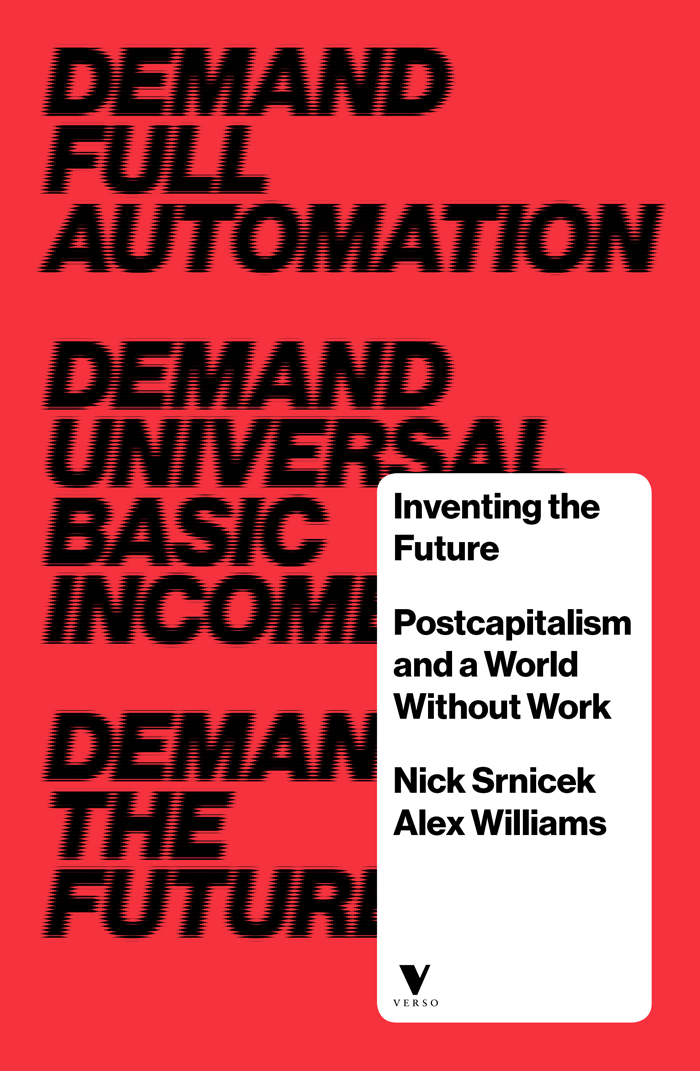
I've written a blogpost - click here to read it - for Verso reflecting on some of the aesthetic implications of the critique of 'folk politics' in their new book by Nick Srnicek and Alex Williams, Inventing the Future: Postcapitalism and a World Without Work:

When, in Inventing the Future, Nick Srnicek and Alex Williams critique the collection of tendencies within the contemporary left they call 'folk politics,' they could also be lamenting the aesthetics that now dominates those areas of popular music that were once progressive. Whether it's underground, or 'indie,' or even happens to be in the charts, contemporary popular music routinely 'chooses the familiarities of the past over the unknowns of the future;... habitually chooses the small over the large' and 'value[s] withdrawal or exit rather than building a broad counter-hegemony'. For independent music as in folk politics, 'organisations and communities are to be transparent, rejecting in advance any conceptual mediation, or even modest amounts of complexity' and both 'emphasis[e] the local and the authentic, the temporary and the spontaneous, the autonomous and the particular'. Srnicek and Williams show that these strategies arose and achieved much in the special political circumstances of the mid-twentieth century, and again, as aesthetic strategies in popular music, they arose during the same period in the countercultural atmosphere of jazz, rock, punk and, indeed, folk musics. And for both folk politics and folk-political music, the time has come to invent what happens next...