Monday, 27 May 2013

Essay: 'Messy' Techno and the Resurgence of Musical Abstraction

Artwork by Rosemarie Fiore (compared to Tlaotlon)
My next Dummy essay is up, '"Messy"' Techno and the Resurgence of Musical Abstraction" (click here), a 'look at the current wave of quasi-techno artists, from Ital to Actress, who are united in their abstract approach and pure sonic sensuality. Featuring Actress, Laurel Halo, Ital, Tlaotlon, AyGeeTee, Lee Gamble, Pete Swanson, Bee Mask and Gobby.
Artwork by Joanne Greenbaum (compared to Lee Gamble)
Sporadically, over the past few years, artists from several surprisingly distinct corners of pop music’s underground have been converging on a particular method: a messy, rough-edged, restless churn of sonic material that’s often associated with techno, but only suggests that genre the way a pile of twisted metal, ash and melted plastic suggests some kind of joyridden and abandoned vehicle...
 Artwork by Fabian Marcaccio (Compared to Pete Swanson)
Classic techno is, or was, futuristic in a very late-twentieth-century way – sleek, shimmering, robotic in the Kraftwerkian sense, metronomically regular, often funky and typically sparkling clean. This more recent kind of “techno” is like turning on a wood chipper and forcing into it several bunches of roses (flowers, stems and thorns), a suite of furniture (wood, fabric, padding and rollers), a collection of Hawaiian shirts (together with the wire hangers), a set of cutlery and crockery (and whatever else was lying around the kitchen), and three decades’ worth of magazine subscriptions to Wallpaper, The Architectural Review and Good Housekeeping...
 Artwork by Julie Mehretu  (compared to AyGeeTee)
This techno’s numerous layers of beats rarely line up with the pitched elements conventionally, and often don’t sync with each other either. Exceeding the inner and outer limits of a conventional groove, this techno expresses everything from a maelstrom of tiny, rapidly cycling cells to Great Red Spots of slowly swelling drones. It most often operates at a high bpm, though in many cases it might be more accurate to say there are several bpms operating simultaneously. This techno makes a virtue of acoustic space and aural proximity – it could be tightly packed and delicately balanced on the tips of your nose and eyelids, or sweeping into the auditory sphere with all the sublime grandeur of an avalanche filling a three-mile-wide valley...
 Artwork by Tomma Abts (compared to Actress)
This techno incorporates the soot and grease and materiality of the electronic audio signal, as well as effects such as heavy compression, as part of its sensual palette in ways that surpass the necessary evil or distancing devices of “lo-fi”. This techno ignores the normal rules of structure, of build-ups, drops and breakdowns, constantly reinventing itself as it rushes along. And forget your 80s synths and drum machines – in this techno, you can barely predict the timbres, colours and textures that wait around the corner...
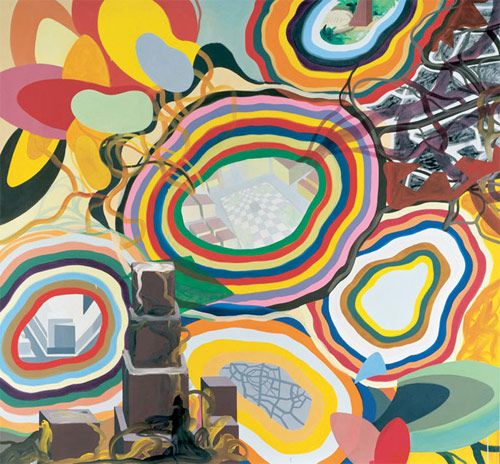
Artwork by Franz Ackermann (compared to Ital) 
What do I mean by this? Well firstly, in learning to appreciate this new breed of techno, I found it helped to look at abstract paintings, and particularly their contemporary resurgence... There is much similarity to be found between the music and the paintings in their use of forms, colours and textures – small and large scales simultaneously, curves and irregularity rather than straight or simple order, elements overlaid to give a sense of space and yet also the creative machine’s materiality to impart a visceral sense of surface, and overall, an undeniable energy flowing from the combination of the sheer quantity of elements on display and the extroverted gestures that bring and bind them together. The formal and sensual interest of these works is of such a degree that their relative lack of direct reference to or connotation of already culturally loaded concepts (such as objects of art/music history or everyday experience) is practically irrelevant...
Artwork by Matthew Ritchie (compared to Gobby) 
This recent style of techno is more abstract because such “figuration” is much less evident, if at all. Its constituent objects are usually too small or basic to register as recognisable elements imported from elsewhere. So instead of making some sort of cultural commentary or offering itself as an easy dance structure, this music, like the painters mentioned above, is about pure sonic sensuality. This conforms to a recent and broad-based shift in the aesthetics of underground pop music. Around the turn of the decade, much of the most popular music was evocative first and foremost, whether it was Romantic, hauntological, retro or conceptual. The culturally and historically distancing effect of lo-fi sonics often played a significant role. Now however, underground pop seems to be moving away from this and slowly rediscovering, with some help from Actress, Laurel Halo and similar artists, the intrigue of pure sound independent of clear, pre-established meaning...
Artwork by Beatriz Milhazes (compared to Bee Mask)

Friday, 10 May 2013

John Maus-flavoured Introduction to Robocop, Explanatory Music Video, Maus Book Reprint

So here's something a bit different. Last week I did a couple lectures in Brussels and Amsterdam in which I talked about John Maus and similar underground pop figures and then we played the film Robocop. Apparently this film is a favourite of Maus's. I wrote a tongue-in-cheek-but-deadly-serious introduction to the movie highlighting the parallels between Maus and Robocop, click here to read it at Subbacultcha.be

In a further attempt to highlight the resonance between Maus and Robocop, I whipped up a little music video for Maus's song 'We Can Break Through', using footage from the movie. Find it on the Subbacultcha page, or uh right here:

Also: Precinct have reprinted my essay / pamphlet on Maus, entitled 'Heaven is Real': John Maus and the Truth of Pop, AND released a new ebook version compatible with Kindle. Browse it and get it by clicking here.

Keep pushing on!

Wednesday, 8 May 2013

Essay: Matthew Herbert's Musical Shell

Next essay for Dummy is up, a discussion of Matthew Herbert's music and processes in the context of his forthcoming album, with a bit of critique in there, feat. Russolo, Marinetti, Wilfred Owen, Arcimboldo (click here to read).

In June, UK composer Matthew Herbert will release an album called The End of Silence, which is constructed almost entirely out of a ten second sample of modern warfare recorded in Libya in 2011: distant gunfire, fighters whistling a heads-up, a pro-Gaddafi jet approaching, and a bomb landing close by. It might be what Russolo would have wanted, but what is the significance – and consequence – of doing such a thing today?

His last album, One Pig, is made from samples of the life and afterlife of a farmed pig, from its birth to its death and to a meal attended by Herbert and friends at which the pig was finally eaten... The project prompted controversy and reached the news, eliciting censure from People for the Ethical Treatment of Animals and a vicious Facebook campaign. Herbert responded articulately and persuasively – the work was not making gruesome, amoral “art” from the butchery of a living being, but rather was a disquieting and arguably necessary look behind the veil of a system in which living beings are industrially created and slaughtered for our consumption...

This time I'm not really so sure... Not because such brutally raw empirical evidence of warfare is automatically too serious a material for art or music – artist Jeremy Deller brought a bomb-mangled car from Baghdad to museum visitors very effectively. Not because it disrespects troops or even victims (it’s left unsaid as to whether Meyer’s impact had any), since the shocking truth is often what is needed to change minds and force action to help such people. It’s because The End of Silence is such a passive, distanced, and ultimately banal response to an intensely active situation...

Bit by bit since Around the House, Herbert’s concepts have been increasingly outweighing the music in gravity, the sonic causes have been outshining the musical effects. Were it not for the crushing, visceral intensity of its having sampled a real-life aerial bombardment, the music on The End of Silence would be interesting and sufficient, rather than what it feels like – as if it’s missing something, not living up to something...

It's not that there's anything wrong or artless about [Herbert's] technique, it's just that when faced with a subject such as modern warfare, it feels so hollow... If the comparison between Arcimboldo and Rembrandt shows us that art can be so much more intense than the reconfiguration of pre-given forms, that sculpture is not merely made out of stones, that poetry is not merely made out of ink, Herbert’s music shows us that no matter where they might come from, music is not just made out of sounds: music is made out of changes, patterns, gestures, sympathies, the warp and weft of difference and repetition...

Monday, 6 May 2013

Pattern Recognition: The New Online Weird


Hey - I've started a new monthly column for Electronic Beats magazine called 'Pattern Recognition'. The first entry is here (click to read), looking at some emerging online experimental beat music producers who work with imaginative contrast, subtly dark mood and inter-textural dissonance. The music linked in the article, by a i r s p o r t s, Karmelloz and RAP/RAP/RAP is certainly worth checking out. There's also a bit on Ferraro's latest phase, Sushi and Cold.

"Surely if music were to be creeping into unvisited territories, the very first thing that you’d notice about it would be its fresh weirdness and a vague sense that it doesn’t quite make sense. This would not be the time to start dismissing new artists, or their online means of distribution and communication, as merely ‘weirder’—it would be the time to start listening very carefully...

Something else marking these producers out is that their music is not particularly conceptual—that is, it’s not obviously ‘about’ anything in particular, and doesn’t overridingly express recognizable cultural concepts before we’ve dived into its abstract qualities, such as mood and sonic characteristics. In today’s underground pop music, this is relatively unusual...

Sushi, however, was much less forthcoming, mysteriously offering nothing but a black cover bearing the title, track names too general and simplistic to suggest anything as specific as before, and sounds that were either too basic or too complex to spark much recognition... This abstract space, where you have little but your senses and your emotions to guide you, is the one a i r s p o r t s, Karmelloz and RAP/RAP/RAP invite you to explore...

“dont need u”, in which the drop is a stuttering voice dangling precariously above a chasm of warm, razor synths. Or “coolDown©”, which is like approaching a giant yellow happy house smiley, only to find out that it’s really a backlit aquarium filled with algal slime and mutant shrimp... “Clarity” is a prancing hypnagogic disco until one of the characters from Street Fighter II shows up and starts pummelling the guests at hyperspeed (and yet the music goes on, he shows up here every night)...

RAP/RAP/RAP’s kick drum is relentless and usually much too loud, the claps and scrapes of the drum machine claw at your ear canals, the background pads and strings are nauseous, the samples are totally unexpected, and the ever-dissonant synths (an advanced case of the relatively rare FM variety) are like bars of sharpened glass. Her/his music is crude, basic and seems urgently purposive, but what the purpose might be is too unreadable for the club. Perhaps it’s in the spectacular contrast-yet-unity between the brutal percussion and the twinkling menace of the chimes...

To date, Karmelloz’s favorite strategies involve careful manipulation of the frequency spectrum, muffling rolling waves of organic ambience and surgically overlaying thin metallic structures and boldly incongruous voices that introduce dissonance. He’s a surrealist, one that has not forgotten that the most troubling dreams are just as much about their scarcely expressible emotional tinge as their bizarre juxtapositions...

Sunday, 28 April 2013

Essay: Shades of Ariel Pink

Ariel Pink / Photo by Nick Haymes
Ariel Pink (photo by Nick Haymes)
I'm back from the US and back writing essays for Dummy regularly. Here's the first one of 2013 (click here to read it) reconsidering the idea of Ariel Pink's influence on the Altered Zones Generation and tracing his own influence, recontextualising him as an echo of 1980s Cassette Culture.

"If you look at the whole of the indie-pop underground wearing Ariel-Pink-tinted spectacles, it should come as no surprise that you’ll only see a multi-coloured scene in monochrome, in shades of Pink...

It hopefully doesn’t need emphasising that Ariel Pink didn’t invent home-recording, or lo-fi, or even retro-lo-fi. In fact, if we look at the history of home-recording and lo-fi, Pink can begin to look like the end of an era rather than the beginning of one. Since the early 1980s, the very same language applied to Pink was being applied to one of his avowed greatest influences and sometime collaborator, R Stevie Moore. Moore was called “the godfather of home-taping” so many times it was practically a cliché...

If anyone can be credited with inventing lo-fi, at least aesthetically, it’s Richie Unterberger and the community of like-minded critics and fans surrounding him. ‘Unknown Legends’s tone of joy mixed with pathos and archeological nostalgia closely matches that of the reviews of Pink’s earlier albums. In its foreword, Lenny Kaye writes of “these dusty corridors of rock ‘n’ roll history, walls covered with posters advertising gigs long encored, and record collections consigned to that great garage sale in the sky”. But it’s when Unterberger turns to one early cassette culture artist who was very popular with Option magazine in the 80s, Martin Newell of the band Cleaners from Venus, that the book really begins to prophecy Ariel Pink. Unterberger describes the band’s early recordings as “lo-fi, murkily recorded affairs that couldn’t hide the power of the melodies, or a wit that could be both tender and savage”, which incorporated “boxy drum sounds” and bore comparison to R Stevie Moore, who was “using the same sort of approach”...

Yet, whether it’s Ariel Pink, R Steve Moore, Richie Unterberger or Martin Newell, it’s of course wrong to pin responsibility for the music of the AZ Generation on any one person. The assumption that history unfolds mainly by individual musicians influencing other individual musicians in a purely musical way is an old-fashioned one that comes from classical music history and its long lines of Great Men and their Great Works. There are greater forces at play, such as taste, technology and social relations. So what might be a better assessment of the historical causes of the AZ Generation? I think the answer’s relatively clear: digital recording technology....

Tuesday, 18 December 2012

10 Moments of 2012

Over at Dummy there's an article from me elaborating on ten significant musical moments from the last year (click here). Feat. Evian Christ, Die Antwoord, Arca, Philip Glass, Willis Earl Beal, Clams Casino, Fay, How to Dress Well and Mykki Blanco. Despite the title and some of the tweets, I wasn't intending that there would be anything definitive or superlative about these moments - if anything they're the sort of moments that might not have been covered in other, more conventional end-of-year lists.

Naturally it was a very cold time of year, and ripped off YouTube, fridge, crank, gun, fuck it none of y’all don’t rap and MYD (released later) felt like they embodied the spindly trees, the nip in the air and the exhalation of small clouds. Their hi-hats shivered periodically across a four-bar phrase, several months before less subtly employed ‘trap’ hi-hats became a cliché. It becomes easier to perceive the back and forth of Evian Christ’s wholly contrasting timbral and rhythmic units if you count along with the beat, 1 2 3 4, 2 2 3 4, 3 2 3 4, 4 2 3 4, you begin to see how well the tracks are put together, and how the mood shifts between the winding up of the rhythm and the gestural, rising and falling sadness of the harmonies.
...
Both solo sections, one by Yo-Landi and one by Ninja, offered fantastic schooling in rapping to a high-speed groove, the dexterity of their prickly accents making you forget to breathe. Yo-Landi’s high voice lilts over a trance rhythm as she narrows and flares her eyes for the camera. Later, after Yo-Landi removes a cockroach from a fry-up, Ninja begins to spit over a steadily accelerating beat. The effect is so exhilarating you wonder why it doesn’t happen more often.
...
If you’d have asked me back in 2009 what kind of music I hoped would be getting produced in 2012, I think I would have hoped for something pretty similar to Arca’s sound. I say this because his style is not unlike that of the psychedelic, so-called ‘wonky’ beat-makers that were beginning to flourish around that time, those who took J-Dilla’s sound and made it sloppier and stranger. Arca’s thing is stranger still, like a Caribbean Reef Octopus coming at you squirting LSD and occasionally rapping in a menacing way out of a small, beak-like orifice on its underside.
...
The opera was filled with fascinating and disturbing tableau – painstakingly slow trains, buses and spaceships, an enormous rising bed, a child judge presiding over a huge, grey courtroom, and an exchange of nuclear missiles complete with a control-room of frantic military personal and a striding Death-like figure in black. These last two images are what haunts E=mc2 and its opening of the door to nuclear power. But another, more basic nod to Einstein could be felt in the opera’s mind-boggling bending of time and space.
...
Dressed like an electric-rhythm-and-blues hipster dustman in South Dakota circa 1958, hidden behind those wayfarers, Beal threw himself a capella down the microphone clenched in his gloved fist, elbow jutting in the air, crouching down slowly, face and arms beginning to glisten with sweat.
...
Casino’s vocal elements melt completely into the mix, and are used for their envelopes, consonant sounds and overtone structures rather than anything as quaint as words or melodies. Likewise, instead of cymbals, Casino just uses a gentle, continuous and fading hissing sound to mark out the groove, and the faintest of metallic sounds, acoustically buried at the back of the mix. Then he lacquers the whole thing with a phaser or flange effect, thus putting it all behind class, or making it into the hull of some sleek vehicle of the future.
...
Every element is placed by hand, just so, and Fay either suspends you over the potential for grooves in a state of rhythmic tension or she drops you into them with relish. Amazingly, though the sound-world is coherently to hand, nothing is predictable.
...
If Rodriguez “isn’t as good as Dylan” as one reviewer suggested, how did he become so successful in South Africa? Were they all mistaken? Perhaps it is Dylan who is not as good as Rodriguez, and we are so aware of the cultural value projected onto Dylan, and his particular methods, that we find it difficult to see it.
...
[Tom Krell] was there, way above middle C, flinching as he looked upwards with his eyes closed, not only during the songs, but in an a capella encore that was both saturated with suspense and silently participated in by an audience now brimming with the utmost warmth and understanding.
...
Much attention has been paid to issues of gender and sexuality among the small crowd of new rappers to have emerged over the past couple of years (Azealia Banks, Lil B, A$AP Rocky, Le1f, Zebra Katz and Blanco) and very rightly so, but I haven’t seen much about quite how radical some of the sounds they’re spitting over are – which, indeed, is not an entirely differentiable matter. Not only does Blanco have the flow, energy and creativity (as well as the subtlety of delivery) to compete with the best, her beats and electronics come from a different planet.