Sunday, 30 June 2013

Essay: Sci-Fi, Hi-Tech, Future?

Another essay for Dummy, on the overlap and mismatch between sci-fi, hi-tech and ideas about the future, and how that pertains to some recent underground pop acts (click here to read). Featuring:  Ford & Lopatin, Zoology Records, The-Drum, many others, and the influence of films, Joe Meek, Kraftwerk, Depeche Mode etc.

Sci-fi, hi-tech and hi-def certainly provide a welcome alternative to the yellowing, musty retro that’s been all over culture in the past decade, and this change is being felt significantly in the new music underground. But does it actually have anything to do with looking towards the future itself?... where does sci-fi end and the future begin?...

It was Kraftwerk who brought the association of hi-tech music with robots into pop music, and alongside them, acts like Tangerine Dream brought in the association of hi-tech music with the cosmos. These associations have in turn given rise to an association between the future and a certain way of writing synthesiser music: basic, stilted, metronomic and repetitive like robots were seen to be – not just more than human but also a lot less than human. This association that persists to this day, even as artists such as Boards of Canada, Stereolab, Broadcast and Daft Punk frame it as historicised, problematic or kitschy...Th idea formed that future music can’t just simply be new – in order to be future it has to be hi-tech and fast in particular ways, much like a sci-fi party will celebrate particular tropes such as robots and aliens that look and sound a particular way...

This late-twentieth-century Kraftwerkian paradigm of future music is beginning to disintegrate and mutate. But with the decline of retro and lo-fi (the two have been practically synonymous) within the tastes of the new music underground comes the rise of hi-tech and of interest in the future...

‘Sense Net’ is an extraordinarily detailed, restless journey through hi-tech and alien spaces bristling with a weird and overwhelming allure. The crazy-rich /BZE is in constant flux, its polygon corridors rotating as you move in anti-grav from module to module with a machine voice repeatedly advising you to ‘stay calm’. The gorgeous ‘/SYS’ is an alien courtly dance in shivering reverb, elegantly counter-posing slices of your human pop music...

For me at least, a genuinely futuristic music should go further than revisiting a series of recognisable, familiar and stable tropes, like those traditionally associated with sci-fi... I think something more futuristic has to be a little more abstract...the music that feels most beguilingly futuristic to me doesn’t wear pre-established concepts on its sleeves, doesn’t simply dress up as something we already thought was futuristic – Arca, Nguzunguzu, Lōtic, I AM WATER, Ikonika, Karmelloz, 18+, Mykki Blanco, Clams Casino. Are these artists astronauts, robots or aliens? Only in the very broadest sense – really they’re something else entirely...

Sunday, 16 June 2013

Pattern Recognition: The Evolving Architecture of the Underground

The second instalment of my new monthly column for Electronic Beats, Pattern Recognition, is on the changed and changing nature of 'the new music underground', along with how and why to keep up with it (click here to read).

"Understanding new music as it arrives every month, delivered straight from the most inventive, passionate, and least commercially-motivated musicians out there, is a profound form of stimulation and exercise for the ear, mind, intellect, and emotions. Following—and participating in—new music culture has been appreciated by its supporters as everything from a hobby to a professional concern to something approaching the meaning of life... It takes work and imagination to engage with fresh and different sounds at their very source like this, but the reward is in learning new methods of listening and thinking...

"The new music underground is an ongoing debate about the possibilities of music, typically conducted at some remove from big commerce. Ideally, it represents an infinite space of possibilities and developments with a coherent, roaming, collective focus acting upon it, like a democratically organized nomadic tribe made up of artists, scientists, and philosophers constantly wandering the universe with disaffected and infinitely open minds, always learning but never settling or capitalizing. In reality, the new music underground is a messy semi-anarchy of interests that make up the rules as they go along, don’t communicate with great efficiency, or move as one...

"In the late 20th century, following new underground music (more often called ‘indie’, ‘alternative’, or ‘non-commercial’ back then) was a more-or-less simple case of subscribing to magazine X, listening to radio show Y, and hanging out in record shop or venue Z. Today’s world is much more fluid, a continuum of ‘undergroundness’ that can be entered at any level. You can imagine this continuum having three main layers...

"With the frontline of new underground music (and the subcultures) potentially shifting onto places like Soundcloud and Bandcamp, some magazines are getting left behind by their near-total reliance on older industry structures such as press releases and PR contacts ...

"A particular focus of anxiety about the new forms of music distribution is how good listening practice is possible in the face of the online and computerized world. The worry goes that there’s too much stuff out there, it’s too easily accessible, and your choice and attention is stretched past breaking point, leaving you floundering in a meaningless chaos of ones and zeroes. It’s mostly unfounded, I think...

Friday, 7 June 2013

Essay: Have You Heard of Eugene Chadbourne?

Illustration by Louis Labron-Johnson
"It’s curious that so few have come across avant-garde-country guitarist Dr Eugene Chadbourne, and that his name doesn’t come up a lot more often both today and in histories of independent pop music. Curious because Eugene Chadbourne was – or seems to have been – one of the biggest and most critically acclaimed stars of the independent scene during its nascent phase in the 1980s... Chadbourne was described as America’s “only anarcho-paramilitary-electro-folkie-troubadelic-matador”, his music as “gonzo audio journalism” that “pushes traditional music to its edge and makes it jump”. At the height of his fame between 1986 and 1988, you almost couldn’t pick up an underground pop magazine without reading a review, article or news item featuring him, and he never needed an introduction... 
"Chadbourne... was swiftly disappearing, crowded out by the consequences of all the new money and attention for the scene. Magazines were becoming glossier and glossier, the bands in them bigger and bigger, and even though lo-fi was very fashionable, the leading artists (Pavement, Beck, Guided By Voices etc) were predominantly released on widely distributed vinyl and CD rather than the mail order of the previous decade. Besides, their music was usually significantly less challenging and unconventional than Chadbourne’s and the avant-gardists within Cassette Culture. Most importantly though, Chadbourne’s whole aesthetic, to the extent that it ever was in fashion, was quickly falling out of it. Alternative rock in the 90s was cool, and Eugene Chadbourne was not cool...
"I’m not saying... that the zaniness was somehow regrettably “mistaken” at the time. My point is that it has been scrubbed from the indie aesthetic agenda so hard that it’s difficult to imagine it as a viable creative possibility today. As early as 1989, one music critic referred in a live review to “Chadbourne’s stale fruitcake routine”. The bands that came to define alternative rock were about as far from zany as they could get. Mainly reacting against the excesses of corporate hair rock, they also set themselves and their behaviour against the underground’s previous generations. Neither clowns nor hippies nor hardcore punks, their demeanour was frank, sincere, understated, streetwise, minimal, a cool passivity, whether it was Beat Happening, R.E.M., grunge, or the notoriously subdued shoegazers... 

Monday, 27 May 2013

Essay: 'Messy' Techno and the Resurgence of Musical Abstraction

Artwork by Rosemarie Fiore (compared to Tlaotlon)
My next Dummy essay is up, '"Messy"' Techno and the Resurgence of Musical Abstraction" (click here), a 'look at the current wave of quasi-techno artists, from Ital to Actress, who are united in their abstract approach and pure sonic sensuality. Featuring Actress, Laurel Halo, Ital, Tlaotlon, AyGeeTee, Lee Gamble, Pete Swanson, Bee Mask and Gobby.
Artwork by Joanne Greenbaum (compared to Lee Gamble)
Sporadically, over the past few years, artists from several surprisingly distinct corners of pop music’s underground have been converging on a particular method: a messy, rough-edged, restless churn of sonic material that’s often associated with techno, but only suggests that genre the way a pile of twisted metal, ash and melted plastic suggests some kind of joyridden and abandoned vehicle...
 Artwork by Fabian Marcaccio (Compared to Pete Swanson)
Classic techno is, or was, futuristic in a very late-twentieth-century way – sleek, shimmering, robotic in the Kraftwerkian sense, metronomically regular, often funky and typically sparkling clean. This more recent kind of “techno” is like turning on a wood chipper and forcing into it several bunches of roses (flowers, stems and thorns), a suite of furniture (wood, fabric, padding and rollers), a collection of Hawaiian shirts (together with the wire hangers), a set of cutlery and crockery (and whatever else was lying around the kitchen), and three decades’ worth of magazine subscriptions to Wallpaper, The Architectural Review and Good Housekeeping...
 Artwork by Julie Mehretu  (compared to AyGeeTee)
This techno’s numerous layers of beats rarely line up with the pitched elements conventionally, and often don’t sync with each other either. Exceeding the inner and outer limits of a conventional groove, this techno expresses everything from a maelstrom of tiny, rapidly cycling cells to Great Red Spots of slowly swelling drones. It most often operates at a high bpm, though in many cases it might be more accurate to say there are several bpms operating simultaneously. This techno makes a virtue of acoustic space and aural proximity – it could be tightly packed and delicately balanced on the tips of your nose and eyelids, or sweeping into the auditory sphere with all the sublime grandeur of an avalanche filling a three-mile-wide valley...
 Artwork by Tomma Abts (compared to Actress)
This techno incorporates the soot and grease and materiality of the electronic audio signal, as well as effects such as heavy compression, as part of its sensual palette in ways that surpass the necessary evil or distancing devices of “lo-fi”. This techno ignores the normal rules of structure, of build-ups, drops and breakdowns, constantly reinventing itself as it rushes along. And forget your 80s synths and drum machines – in this techno, you can barely predict the timbres, colours and textures that wait around the corner...
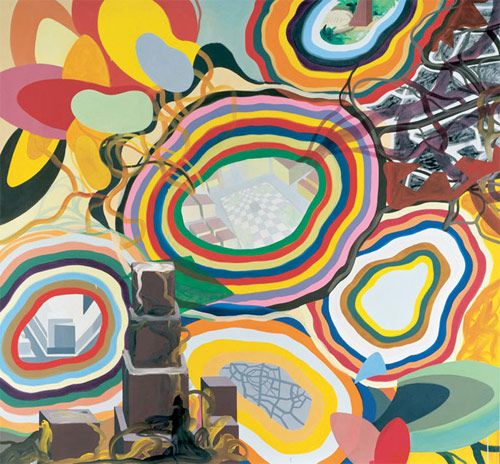
Artwork by Franz Ackermann (compared to Ital) 
What do I mean by this? Well firstly, in learning to appreciate this new breed of techno, I found it helped to look at abstract paintings, and particularly their contemporary resurgence... There is much similarity to be found between the music and the paintings in their use of forms, colours and textures – small and large scales simultaneously, curves and irregularity rather than straight or simple order, elements overlaid to give a sense of space and yet also the creative machine’s materiality to impart a visceral sense of surface, and overall, an undeniable energy flowing from the combination of the sheer quantity of elements on display and the extroverted gestures that bring and bind them together. The formal and sensual interest of these works is of such a degree that their relative lack of direct reference to or connotation of already culturally loaded concepts (such as objects of art/music history or everyday experience) is practically irrelevant...
Artwork by Matthew Ritchie (compared to Gobby) 
This recent style of techno is more abstract because such “figuration” is much less evident, if at all. Its constituent objects are usually too small or basic to register as recognisable elements imported from elsewhere. So instead of making some sort of cultural commentary or offering itself as an easy dance structure, this music, like the painters mentioned above, is about pure sonic sensuality. This conforms to a recent and broad-based shift in the aesthetics of underground pop music. Around the turn of the decade, much of the most popular music was evocative first and foremost, whether it was Romantic, hauntological, retro or conceptual. The culturally and historically distancing effect of lo-fi sonics often played a significant role. Now however, underground pop seems to be moving away from this and slowly rediscovering, with some help from Actress, Laurel Halo and similar artists, the intrigue of pure sound independent of clear, pre-established meaning...
Artwork by Beatriz Milhazes (compared to Bee Mask)

Friday, 10 May 2013

John Maus-flavoured Introduction to Robocop, Explanatory Music Video, Maus Book Reprint

So here's something a bit different. Last week I did a couple lectures in Brussels and Amsterdam in which I talked about John Maus and similar underground pop figures and then we played the film Robocop. Apparently this film is a favourite of Maus's. I wrote a tongue-in-cheek-but-deadly-serious introduction to the movie highlighting the parallels between Maus and Robocop, click here to read it at Subbacultcha.be

In a further attempt to highlight the resonance between Maus and Robocop, I whipped up a little music video for Maus's song 'We Can Break Through', using footage from the movie. Find it on the Subbacultcha page, or uh right here:

Also: Precinct have reprinted my essay / pamphlet on Maus, entitled 'Heaven is Real': John Maus and the Truth of Pop, AND released a new ebook version compatible with Kindle. Browse it and get it by clicking here.

Keep pushing on!

Wednesday, 8 May 2013

Essay: Matthew Herbert's Musical Shell

Next essay for Dummy is up, a discussion of Matthew Herbert's music and processes in the context of his forthcoming album, with a bit of critique in there, feat. Russolo, Marinetti, Wilfred Owen, Arcimboldo (click here to read).

In June, UK composer Matthew Herbert will release an album called The End of Silence, which is constructed almost entirely out of a ten second sample of modern warfare recorded in Libya in 2011: distant gunfire, fighters whistling a heads-up, a pro-Gaddafi jet approaching, and a bomb landing close by. It might be what Russolo would have wanted, but what is the significance – and consequence – of doing such a thing today?

His last album, One Pig, is made from samples of the life and afterlife of a farmed pig, from its birth to its death and to a meal attended by Herbert and friends at which the pig was finally eaten... The project prompted controversy and reached the news, eliciting censure from People for the Ethical Treatment of Animals and a vicious Facebook campaign. Herbert responded articulately and persuasively – the work was not making gruesome, amoral “art” from the butchery of a living being, but rather was a disquieting and arguably necessary look behind the veil of a system in which living beings are industrially created and slaughtered for our consumption...

This time I'm not really so sure... Not because such brutally raw empirical evidence of warfare is automatically too serious a material for art or music – artist Jeremy Deller brought a bomb-mangled car from Baghdad to museum visitors very effectively. Not because it disrespects troops or even victims (it’s left unsaid as to whether Meyer’s impact had any), since the shocking truth is often what is needed to change minds and force action to help such people. It’s because The End of Silence is such a passive, distanced, and ultimately banal response to an intensely active situation...

Bit by bit since Around the House, Herbert’s concepts have been increasingly outweighing the music in gravity, the sonic causes have been outshining the musical effects. Were it not for the crushing, visceral intensity of its having sampled a real-life aerial bombardment, the music on The End of Silence would be interesting and sufficient, rather than what it feels like – as if it’s missing something, not living up to something...

It's not that there's anything wrong or artless about [Herbert's] technique, it's just that when faced with a subject such as modern warfare, it feels so hollow... If the comparison between Arcimboldo and Rembrandt shows us that art can be so much more intense than the reconfiguration of pre-given forms, that sculpture is not merely made out of stones, that poetry is not merely made out of ink, Herbert’s music shows us that no matter where they might come from, music is not just made out of sounds: music is made out of changes, patterns, gestures, sympathies, the warp and weft of difference and repetition...